Anxiety Relief, Personal Development

How To Bounce Back from Time Off

Taking time off as an entrepreneur is a necessity to help rejuvenate and inspire us to continue to chase after our dreams.  However, it can be challenging to get back into the swing of things and get back on track with our daily routines.

Dishes and laundry start to pile up, leaving out brains completely cluttered and seemingly negating the relaxation we just enjoyed.

It’s no secret that mitigating this inevitability takes discipline! With that in mind, here are my three tips to help you stay on track after some prolonged relaxation.

1. Create a list of non-negotiables.

What I mean by this is that you should identify a list of activities or practices you adhere to every day without question to help maintain your wellbeing while you are on vacation or taking time off. Even if it’s as simple as drinking eight glasses of water, getting adequate sleep, or sifting through your work email, continuing to do this every day will keep you in a rhythm that makes returning home to the daily grind that much easier.

To begin, start with a small list of five or fewer activities. Doing so will give you easy wins and help you build confidence in your routine.

I make sure that I listen to my daily affirmations, meditate, write in my gratitude log, drink ample water, and stretch/do yoga daily. This list of non-negotiables allows me to hit the ground running as soon as I get home.

2. If possible, take an extra day off when you return from your vacation.

I understand this tip is potentially not feasible for everyone, but I have found benefit in scheduling a half day for the day I return from a long trip. Doing so allows me to help situate myself back into my own home. Whether starting laundry or getting groceries, it prevents me from falling into bad habits like eating fast food to save time.

3. Get help!

You do not need to do everything on your own! Consider having groceries delivered to your door when you get home, so you don’t have the added stress of immediately heading out to the store for fresh food. Or maybe you could order DoorDash the day before you leave so you don’t have to come home to a sink full of dishes.

I hope these tips are helpful! If you struggle to figure out how to bounce back from a routine, consider working with me through my monthly membership program, Inner Compass Support. For information, click here.

Mental health

Manifesting and Mental Health

No matter where you look these days, you will probably hear something about the practice of “manifesting.”

As someone who provides mental health therapy and has developed an online program tailored for healing past trauma, I get asked a lot about my feelings on manifesting.

Manifesting is the process of intentionally bringing your desires and goals into reality through focused thought and positive energy.  While on its surface this seems like a spiritual or mystical concept, manifesting can help your business by encouraging you to remain focused, motivated and positive as you work toward your business goals.

As with so many mental health practices, there are pros and cons to the manifesting world, but ultimately I feel that manifesting results in a net positive in my life.

The key is to find the proper balance between what works well and what doesn’t.

Unsure of whether or not you want to dive headfirst into the manifesting world? Let me tell you some of the pros and cons I have experienced since dedicating myself to the practice.

Pros

  1. It promotes a positive mindset. 

    Cognitive behavioral therapy is based on the idea that “if we can change our thinking, it will change our feelings and thus change our actions.” Manifesting is similar, as it helps put you in the driver’s seat of your mental health by attempting to promote a positive train of thought. Whether it’s through journaling, meditating, or writing a gratitude log, these will all help us rewire the brain for positive psychology.

  2. Take charge of your healing.

    One of the manifesting coaches I follow is named Brad Yates, and he starts all of his EFT Tapping sessions off by saying that “we have the choice to take full responsibility for our own well-being.” Trauma survivors often think that only bad things happen to them and that they are a victim of their own circumstances, nothing else. Healing this belief lets you see that you are capable of much more.Manifesting also emphasizes doing “shadow work,” where you attempt to heal your past wounds, fears, and anxieties. Doing so makes room for new experiences, feelings, and beliefs. Think about it; if you were going to buy a new couch, you would need to make sure you made enough space in your living room for the couch first!

    Investing in our well-being in the present will benefit our future selves.

  3. You are in charge of your own destiny.

    Tony Robbins often refers to the term a “compelling future” when discussing how to handle the stress life throws at you. What he means by this is that if you mentally tell yourself that you will have whatever it is you desire in the future, it will give you the strength to handle stress better as it presents itself.

Cons

  1. It can be a culture of toxic positivity.

    Earlier this year, someone broke into my office and damaged and stole property. I was devastated. It felt like they had stolen more than just property that evening.Unsure of how to process the event, I decided to share my story on Instagram. Mostly, I was met with overwhelming support from my friends, family, and followers. But, I also received messages from some of my friends within the manifesting world who were attempting to put a positive spin on what had happened.”How might this end up helping you out in the long run?””What is wrong with your energy?” “Can you imagine what that person must have been going through to do this?”

    While there was no ill-intent among these sentiments, the truth was that this event had nothing to do with me or my energy but rather was caused by another person utilizing their free will to break into my office. At this moment, I needed to feel the hurt of having my safety violated.

    If we do not allow ourselves to hurt, we never allow ourselves to heal. Instead, we end up burying these emotions and creating future roadblocks to our success and happiness.

    One way I like to put it: how could we appreciate the sun if there were no rainy days?

    2. The “everything happens for a reason” dilemma.

    Within the manifesting world, the phrase “everything happens for a reason” can get tossed around quite frequently, and I disagree with the sentiment. Sure, this applies in many scenarios, but as a licensed mental health therapist, I have seen things that happened to people I wouldn’t wish on my worst enemy. These types of severe traumas cannot be just dismissed as an event that “happened for a reason.” Otherwise, it causes the victim to feel like something is wrong with them or that they have inherently bad energy.

    People have the free will to do good or bad. Some things happen to us that are entirely beyond our control. These events should not always be dismissed as a potential stepping stone toward a greater purpose.

Through the good and bad, I feel that manifesting has given me the personal space to help organize my thoughts and feelings. It also has empowered me to feel as though I can heal my past and present so I can move forward in my life and embody the person I want to become.

I will warn you that the benefits are not immediate and may take a trial and error period.

We are not stuck with our belief systems. We can heal what is no longer serving us and move forward to the goals we are excited to achieve.

Still unsure if manifesting is a practice for you? Click here to take my free masterclass!

Anxiety Relief, Personal Development

Travel Anxiety Relief

Summer is in full swing, and for many of us, it is time to take a break from our busy lives and travel!

Unfortunately, while traveling is exciting for many of us, it can ignite anxiety symptoms for others.

I know this to be true from personal experience. My anxiety used to ramp up during travel to the point that I couldn’t eat before or during the trip. My brain just stirred in circles over the fear of forgetting to pack something or not having my itinerary booked correctly.

Over several years I have developed five tips that help me avoid spikes in my anxiety while traveling. Whether in the airport, on the flight, or at my hotel, these are the tips I swear by!

  1. Visualization: When I am on my flight, I try to sit back and visualize how I will feel fifteen minutes after I have arrived at my destination and am ready to enjoy the trip. While doing this visualization, I ask myself, “what would each of my five senses be experiencing during this moment?” For example, I recently took a trip to Hawaii, and while on the plane, I imagined what it would feel like when I first got to the sandy beaches of Waikiki. I visualized the feeling of the sand between my toes as I took a deep breath of the salty ocean air and put my beach towel down. I envisioned myself sitting down and soaking in that beautiful, deep blue ocean color as the waves quietly crashed to the shore while drinking my favorite iced coffee. By activating my five senses during the visualization, I can stay present and avoid the stress associated with travel.
  2. Make a DIY calming jar: This is one of my mainstays for anxiety. With just the two ingredients of baby oil and glitter, you can create a versatile calming jar that can be taken anywhere! I like to use the jar by watching the glitter slowly fall while I focus on my breath. Try it out; you might find it soothing. Unsure of how to make one, watch my how-to video here!
  3. Read a book: In my experience, reading books are more effective than watching a movie to calm your anxiety while passing the time. This is because you are forced to use your imagination and thus activate your prefrontal cortex while reading a book. When your prefrontal cortex is activated, it has a diminished capacity to focus on thoughts of anxiousness. Contrarily, when you watch a movie, your brain can drift off; thus, your prefrontal cortex is shut off, and your anxiety amplifies. If you are not someone who enjoys reading, consider doing something active like journaling or drawing. Maybe even jot down a list of all the things you are hoping to do while you are on vacation.
  4. Magnesium: Taking magnesium can help lower muscle tension and thus lower those panicked feelings of anxiety. It’s a safe and easy over-the-counter solution that I cannot go without!
  5. Breathing exercises: If you follow any of my social media platforms, you have probably heard me talking about triangle breathing. It’s an easy three-step process that you can imagine in the shape of a triangle to help naturally reduce anxiety symptoms. First, inhale for four seconds, then hold your breath for four seconds, and finally, exhale for four seconds. By changing your breathing pattern, you can naturally regulate your heart rate and thus reduce the feelings of anxiety.

Hopefully, these tips can help you feel empowered on your next trip from home.

Struggling with anxiety more often than just flying?

Stay tuned to this blog for more mental health tips!

Anxiety Relief, Mental health, Personal Development, Trauma Healing

How to Start a Gratitude Practice

During my 2nd year of graduate school, I began experiencing the pendulum of anxiety swinging to depression. Searching for a solution, I ended up taking a workshop on how incorporating a practice of gratitude can help decrease your symptoms of both anxiety and depression. I decided to commit to spending five minutes a day writing what I am grateful for, and on the days where I struggled to find gratitude, I would go back and revisit past entries for inspiration. I found it beneficial because it was gratitude in my own words, not someone telling me to be grateful. This is why I encourage all of my friends, clients and family to start a gratitude practice.

If you have noticed that you have difficulty focusing on the positives rather than the negatives, you are not alone. This is because we have had what is known as the “negativity bias” hardwired in our brains since the primitive ages. At that time, this was a crucial survival tool that allowed us to prepare for and navigate the worst-case scenario in each situation.

However, just because this was programmed into our nervous system thousands of years ago doesn’t mean we are helpless. That is where the power of gratitude comes in!

Whether you choose to verbally recite or jot them down in a notebook, formulating a list of things we are grateful for helps rewire our brain to remain in a positive state. I have an app that gives me a daily prompt of things I am thankful for that day.

If you are new to practicing gratitude, you are in luck, it’s easy, and there are no rules on how to do it. Putting in the effort is what matters.

I recommend my clients start by stating or journaling between 3-10 things they are grateful for within the last 24 hours. This helps us stay grounded in the present and prevents the tasks from becoming repetitive over time.

Maybe you are grateful for the discount you got on groceries, how great the outfit you wore to work looked, and how the sunset looked on this beautiful spring evening. Boom! You’re done! It is that easy.

Still unsure? Here are five benefits of having a consistent gratitude practice.


  1. Gives Us Hope for the Future

    If you can find a way to be grateful for the small milestones you accomplish today, think about how you will feel when you truly achieve your dreams?


  2. Reduced Stress

    Loads of research have shown that keeping a daily gratitude journal can help lower cortisol levels and, as a result, signal our body to relax.


  3. Improves Sleep

    By lowering our stress, we can sleep much more freely. Plus, if you wake up and cannot fall back asleep, rather than check your phone, start reciting things you are grateful for and watch yourself slowly doze back off to sleep.


  4. Boosts Self-Esteem

    You will often be writing about things you have accomplished. What better way to remind yourself of your successes than seeing them written down on paper?


  5. Instantly Boosts Your Mood

    Focusing on all the positives in your life makes it that much harder for your brain to drift back toward the negatives. Plus, on days that seem especially hard, you can return to previous days and remind yourself of all the things you have been grateful for. The best part about it? It’s written in your own words. It’s not a friend or coworker trying to convince you that your life is fantastic. You already did that heavy-lifting!

Through your journey as an entrepreneur, your emotions will undoubtedly vacillate from high to low depending on your success.  This is why I encourage my clients to start a gratitude practice to help them cultivate a positive mindset, allowing them to avoid the severe pendulum swings that seem almost built-in to the entrepreneurial experience. 

It can be easy to forget to focus on our lives’ beautiful aspects with an increasingly hostile world around us. That is why I cannot emphasize enough the importance of developing a gratitude practice as part of your daily routine.

Start getting in the habit today! There is no wrong way to add gratitude to your life.

Mental health, Personal Development

How To Set Boundaries

When we are goal setting or embarking on our mental health journey, one of the most important steps we can take to ensure our success is implementing boundaries.

Setting and maintaining boundaries seems simple on its surface, but they often get neglected! This is because of our natural trauma response of wanting to be a people-pleaser at all times. As a result, our needs get shoved to the side, and our personal growth plateaus.

Boundaries are particularly important for entrepreneurs, as they help create an environment that cultivates productivity, focus and well-being.  Entrepreneurs who do not set boundaries often struggle to create an optimal work-life balance and eventually burn themselves out.

Unsure of where to start to set healthy boundaries? Here are my three favorite tips for setting boundaries!

1. Establish why you are creating the boundary in the first place.

I love to remind my clients that if you can get behind the “why,” it will be easier for them to maintain the boundary.

For example, let’s say you consistently have been working overtime at your job and come home and are too tired to cook yourself a meal or exercise. As a result, your health has been negatively impacted because you spend more time than ever watching television and have resorted to eating out for most of your meals.

Suppose you decide to set a boundary not to work overtime anymore as it will allow you to live a healthier lifestyle. In that case, your brain will understand the importance of the boundary and find the motivation to adhere to it.

Once the “why” is established, the rest is smooth sailing!

2. Figure out how the boundary will benefit you.

Boundaries can be rewarding, whether you have improved energy, less anxiety, or more time to do things you love. And if there is one thing that we know about our brain, it’s that it loves to be rewarded. Therefore, if the brain knows it’s benefiting from a boundary, it will continue to attempt to maintain the boundary.

One boundary I have been more adamant about nurturing is not to stay late at events when I have a myriad of tasks I still need to complete. I often set a timer on my phone and force myself to stick to it. As a result, I accomplish more tasks and feel less anxiety than ever before.

3. Let others around you know about the boundaries that you have set. 

This might be the most crucial tip for setting a successful boundary. By letting others know your expectations of a boundary, they will be more understanding of your need for space and less likely to pressure you.

For example, maybe you just started school or enrolled in my course Inner Compass Accelerator, and know that you will need the weekends to yourself to be as focused as possible. By having a conversation with your support system about this need, they will understand your expectations of their friendship while you try to get the most out of your class. They will also feel less blindsided by you canceling or having to continually raincheck on plans.

But be aware that they may not always be agreeable with the boundary you are attempting to set. It is your job to be firm about the importance of the boundary!

Still unsure on how to go about setting healthy boundaries? My course Inner Compass Accelerator dives deep into the topic!

Anxiety Relief, Mental health, Personal Development, Trauma Healing

What is the difference between EFT and EMDR?

Are you starting to embark on your healing journey and find yourself researching ways to jumpstart or accelerate the healing process?

You may have come across the terms Emotional Freedom Technique (EFT) or Eye Movement Desensitization and Reprocessing (EMDR). Both are widely accepted and prominently used models in psychotherapy that help reprocess past experiences.

When we are actively healing trauma, we need to rewire and strengthen the neural pathways in our brain. This is necessary because our brain tends to get “stuck” and focus on the negative aspects of past experiences. For example, a person who survives a car crash often agonizes and relives the traumatic portions of the event, rather than finding solace that they survived the event and became more appreciative of the fragility of life.

Both EFT and EMDR require the brain and body to reprocess your trauma by simultaneously stimulating both sides of your brain. Ultimately the aim is to allow yourself to view the full scope of an event.

When I discuss EMDR with my clients, we start by understanding the role rapid eye movement plays in processing our day. As you may know, the portion of deep sleep is known as REM-sleep, or rapid eye movement sleep. When we reach this level of sleep, our body is essentially paralyzed outside of our eyes, which flicker back and forth as we process the day’s events. If that day was particularly traumatic, the events can get “stuck” and develop into recurrent nightmares, physical manifestations, or dramatic shifts in our personalities.

With EMDR, we want to tap into the brain’s ability to process and digest memories. During a session, you will discuss a problematic memory with a licensed professional while moving their fingers back and forth while you track with your eyes. Sometimes they may use a light bar, a set of buzzers, or ask you to tap your shoulders as an alternative. Regardless of the practice, the idea is to activate both sides of the brain and help us stop reliving our trauma, and allow us to move forward in our lives.

EFT is a similar practice but does not require the guidance of a licensed professional. Instead of following a finger back-and-forth with your eyes, you will be tapping on different meridian points while desensitizing yourself to the stressful memory. I like to think of it as a form of emotional acupuncture.

Now that you have a better understanding of the basic concepts let’s talk about some similarities and differences.

Similarities
  • Both focus on rewiring the brain to process traumas, fears, and limiting beliefs.
  • Both incorporate the mind-body connection by stimulating the left and right hemispheres of the brain.
  • Both use the Subjective Units of Distress Scale (SUDS) to measure progress objectively.
  • Both focus on our earliest memories rather than our most severe ones. For example, if you fear public speaking rather than focusing on the worst sensation you’ve felt, you are asked to think of why this fear originated in the first place.
  • While public speaking, the aim is to pin the earliest time the physical sensation was present in your body. Our oldest memories are the ones our brains return to the pull evidence to support their desire to catastrophize an upcoming decision.
Differences
  • Anyone can be trained in EFT, making it more accessible. When I got certified in EFT, I took an 8-hour class with an exam at the end.
  • EMDR, on the other hand, requires a master’s level therapist or a therapist working towards a master’s degree while under the supervision of a licensed therapist. Because EMDR tends to bring up intense memories, someone with experience in therapy must be present to help you stay in your body and prevent you from dissociating.
  • In my experience, EFT is less intense because you are focusing on how the memory feels in your body rather than solely on the memory. EFT helps remove the feeling in your body to allow you to discuss then and further heal the trauma.
  • EMDR, on the other hand, focuses on the image without talking or looking inward.
  • EMDR “butterfly tapping” can be helpful to do at home but is more effective when done with a licensed professional.
  • You can do EFT on your own. Many free resources on Pinterest and YouTube can help guide you through EFT tapping protocols. While there are YouTube videos that take you through EMDR sessions, I personally would not recommend these as I had had clients do them in the past and found themselves more triggered than ever before because there was no one present to help guide them out of their altered mental state.
As a provider, I am always looking for new and effective tools for my clients to utilize. In 2015 I got trained in EMDR, and every few years, I participate in additional training to help support my clients. My first introduction to EFT came in the summer of 2021. After my first experience with it, I felt a significant benefit and knew I had to get certified in this modality as well.

Being trained in both, you might ask which I prefer or find most effective… 

The answer is that you really can’t go wrong with either one! I practice EFT on myself regularly, as I don’t always have the opportunity to sit down with a licensed therapist to do EMDR. I recommend trying both and finding out which one works best for you.

The important thing is that you are actively striving to make yourself a better person!
Anxiety Relief, Mental health, Personal Development

H.A.L.T.

Ever have one of those days where you’re trying to make a decision about the direction of your business but your brain just doesn’t seem to be clicking like you’re accustomed to?

Don’t be alarmed! It happens to the best of us.  


When I feel out of sorts, my favorite tool to evaluate why I am not feeling myself is the simple acronym of H.A.L.T. 
H.A.L.T. in this circumstance does not simply mean to stop what you are doing; it acts as a helpful tool to help us evaluate what is causing a change in our mood. 

H = Hungry

A = Angry 

L = Lonely 

T = Tired


Hungry

Crashes in blood sugar are known to cause mood swings and changes in mental status. When we return these blood sugar levels to the normal range, whether eating a meal or a quick snack, we can expect many of these symptoms to resolve. So the next time you might be feeling a bit more irritable or reactionary, the first thing you should ask yourself is, “when was the last time I ate?”   

Hunger does not exclusively have to relate to food. There are times we have “emotional hunger,” in which we crave a human connection. When this occurs, don’t hesitate to reach out to a friend or coworker and let them know that you need extra support.


Angry

In my course Inner Compass Accelerator, we dive deep into what anger is and how it often presents itself. I emphasize with my clients that anger is a secondary emotion, meaning that below the surface, there is another emotion driving the anger. 

Whether it’s resentment, frustration, jealousy, or embarrassment, we use anger to meet our emotional needs. This can be seen as having a short temper, cutting someone off, or just being downright rude because you feel like it!

Try and take time to connect to your body and figure out what is causing this anger to come forward, then take a deep breath yourself, “how can I express what my true emotions are with a more pleasant and constructive attitude.”


Lonely

Loneliness is something we have all been through and can acknowledge the negative changes in our mood that come as a result. Whenever I feel lonely, I try to ask myself, “when was the last time I had a quality connection with a friend or loved one?” 

The pandemic has taught us that there are many ways to connect with others, whether in person, on the phone, through FaceTime, or just a good old-fashioned handwritten letter. You will be stunned by the power you have to improve your overall mood by just talking with someone about how their day went.

Sometimes we will even self-isolate ourselves on purpose. I cannot emphasize enough that you do not need to do this to yourself! You never should feel like you must deal with things on your own. If you feel lonely, reach out! Even those of us who identify as an introvert need physical connection.


Tired

Whether physical or emotional, we can exhaust ourselves to the point we feel drained. When this happens, try to navigate why you might be feeling this way with yourself. Did you have a stressful deadline you needed to meet at work? Did you have a medical appointment that you had been ruminating on for a while?

Regardless of the cause, you need to find ways to rest and relax so you can recharge! Maybe you need to go to bed earlier, take a nap or vegetate and watch one of your favorite TV shows. 

The next time you notice you are not feeling yourself, tell yourself to “H.A.L.T.!” It is your body’s way of telling you to “do something different and get our basic human needs met!”  

If you are struggling with knowing whether you are genuinely feeling off, check out my YouTube video on how to do a Body Scan!
Anxiety Relief, Mental health, Personal Development, Trauma Healing

Five Benefits of Healing Your Trauma


Back in January, I did my first ever YouTube Live. As the nerves were settling in, I took a moment to pause and reflect on how far I had come since posting my first YouTube video back in 2020. If you had told me back then that I would ever have the courage to go live on YouTube, I would have said that you had lost your mind! Until recently, I considered myself risk-averse, so what changed? The answer is pretty simple: I invested the necessary time into healing my past trauma.

But Alyssa, healing your trauma sounds intense! Who wants to be reminded and have to relive awful memories? Most of us would rather “keep calm and carry on.” While that motto seems like the safer route, there are several benefits to healing your trauma! Let’s dive into what I feel are the five most essential advantages of healing your trauma.

1. Feeling Validation and Acknowledgment

We often downplay the trauma we have been through as a defense mechanism, telling ourselves and others things like “it was so long ago” or “you know it really wasn’t that bad.” In reality, trauma can negatively impact our lives, regardless of how others interpret its severity.

When I am doing trauma work with a client, we focus on validating what happened to us. We acknowledge that these negative experiences were not okay and that it is okay to feel sad that they occurred.

This validation can help us process and move forward, cultivating a sense of safety that we can live our truth and not force ourselves to downplay past experiences.

2. Acquire New Coping Skills

As we heal our trauma, we develop new coping skills that allow us to manage past, present, and future traumas more efficiently. Not everyone’s coping skills will be the same, but we will find skills that best suit our needs with practices.

One of the most significant benefits of healing our trauma is getting rid of the layering effect. Without healing trauma, we continue to compile trauma on trauma, which adds more and more stress to our plates. Instead, we are now given somewhat of a blank slate, allowing us to remain in the present and worry about the here and now.

In my course Inner Compass Accelerator, we dive deep into the idea of widening our window of tolerance. As our window of tolerance expands, the more stress we can handle and the less fear we develop about experiencing future stressful situations.

3. Understanding How Your Trauma Has Impacted You
Our trauma causes us to see our lives through a distorted lens. This lens often catastrophizes the worst possible outcome in every scenario. As a result, our decision-making changes. We try to “play it safe” rather than take the necessary risks to live the life we desire.

Understanding how our trauma has impacted us changes our perception of what we are capable of achieving. It also unlocks our ability to find more joy in life, ultimately allowing us to live the life we truly want to live. Who knows, after healing your trauma, you may have a career change or find the courage to get back out there and search for your soul mate.

4. Improved Self-Worth

Trauma survivors often blame themselves for their experiences, saying things like “I should have listened to them” or “why didn’t I just stay at home,” etc. This type of thinking is toxic and can lead us to go into a “shame-spiral” that prevent us from chasing after our goals and dreams.

When we heal our trauma, we no longer waste precious moments of our lives shaming ourselves for the painful experiences. This newfound self-love allows us to bounce back from stress.

5. New Sense of Self
By healing your trauma, you will believe that things are possible that you would never have thought about before.

You will no longer find yourself scrolling through social media, seeing other successful people, and thinking, “they have something that I don’t.” Instead, you will say, “I have the same ability to be successful; I just need to nurture it.”

As an entrepreneur, it can be difficult to balance the demands of running a business with the need to heal traumas from your past.  Believe me, of all people, I get that.  But prioritizing your mental health and well-being is essential for setting yourself up for success in both your personal and professional life.

If you believe that you have past traumas that are holding you back and don’t know how to begin resolving them, I have two ways you can work with me at this time. You can either join my self-paced course Inner Compass Accelerator, or schedule one-on-one sessions to work with me directly.

Anxiety Relief, Mental health, Personal Development, Trauma Healing

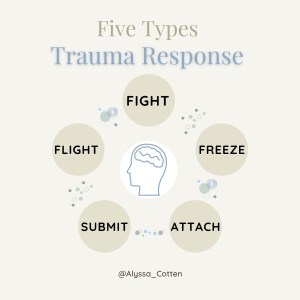
5 Types of Trauma Responses

Have you ever wondered why you act or respond the way you do during stressful situations?

This is something I ponder a lot, then one day, while I was attending a training, it hit me: most of us are just reacting to being triggered by trauma!

Trauma comes in all shapes and sizes and is something we all deal with regularly, regardless of where we are currently in our lives. Trauma at its core is something you perceive to be a negative past or present experience. Trauma causes a knee-jerk reaction in our nervous system that ultimately decides how we respond to the situation.

A typical example of this that you may have heard of is the “fight or flight” response. Often, this example is described as a situation such as a hiker accidentally running into a bear in the wilderness and is left with two choices: fight the bear or run.

However, it may surprise you to find out that there are five different trauma responses, not just these two choices. 

Before diving into each of these responses, it’s essential first to understand why these automatic physiologic reactions occur at all when we perceive stress.  
The prefrontal cortex of our brain controls judgment, decision making, personality expression, planning complex behaviors, and moderating social behavior. When trauma occurs, our brains go offline, and we rely upon our autonomic nervous system to take over. 

In the case of our hiker analogy, when the hiker hears or sees the bear, their prefrontal cortex doesn’t have enough time to interpret, process, and analyze the situation. Instead, it interprets and then immediately reacts. 

Our emotional trauma responses are similar to this mechanism. Whether the trauma happened five seconds ago or five years ago, our brains are wired to have instinctive reactions.

It is absolutely essential for entrepreneurs to be aware of the signs of their trauma responses so they are able to identify and react appropriately when they occur.  Otherwise, trauma responses can lead to decreased productivity, missed deadlines, hostile work environments and impacted team morale. 

My hope with this blog post is to provide you with an understanding of each of the five different trauma responses. Comprehending each of their signs and tendencies allows us to illuminate our negative behaviors and unhealthy coping habits. 

In no particular order, here are the five different trauma responses:

Fight:
  When experiencing the “fight” trauma response, individuals develop a need for control and become combative and vigilant. Maybe you will notice you’ve become more argumentative with a loved one than usual. Or that you have become more mistrustful or judgmental than you had been in the past. This response can lead to self-destructive or self-sabotaging tendencies.

Flight:
  With the “flight” trauma response, individuals will find themselves doing anything possible to avoid or escape a situation. Whether it’s distancing yourself from friends, refusing to commit to plans, or consuming social media rather than creating your own life experiences, this trauma response can be just as harmful to our mental health as any other.  

Freeze: 
When someone is in the “freeze” trauma response, they are consumed by fear and will only see the bad in situations. Generally, people will be overwhelmed with anxiety and the desire to fly under the radar and be more passive in social settings.

Submit:
 The “submit” trauma response is precisely what it sounds like: the person has submitted themselves to defeat or shame from the situation. Often those experiencing this will have an attitude of “why bother, I know I have lost” to whatever stressors present themselves to them. This manifests into self-hatred and causes them to stop working toward personal goals.

Attach:
 Those who experience the “attach” trauma response will do anything to help themselves feel connected. Whether it’s remaining in a toxic relationship or having promiscuous sex, this trauma response is fueled by a fear of abandonment. Many will feel like they need a connection with another human to help them navigate them through the day. 

These trauma responses will ebb and flow throughout our lives depending on the situation. Our bodies rely on them to protect ourselves from traumatic experiences.  

I encourage you to give compassion when you check in with your body during stressful situations and understand that these trauma responses are normal!
If you have made it this far and are interested in exploring this topic further, check out this video!