Anxiety Relief, Mental health, Personal Development, Trauma Healing

Five Benefits of Healing Your Trauma


Back in January, I did my first ever YouTube Live. As the nerves were settling in, I took a moment to pause and reflect on how far I had come since posting my first YouTube video back in 2020. If you had told me back then that I would ever have the courage to go live on YouTube, I would have said that you had lost your mind! Until recently, I considered myself risk-averse, so what changed? The answer is pretty simple: I invested the necessary time into healing my past trauma.

But Alyssa, healing your trauma sounds intense! Who wants to be reminded and have to relive awful memories? Most of us would rather “keep calm and carry on.” While that motto seems like the safer route, there are several benefits to healing your trauma! Let’s dive into what I feel are the five most essential advantages of healing your trauma.

1. Feeling Validation and Acknowledgment

We often downplay the trauma we have been through as a defense mechanism, telling ourselves and others things like “it was so long ago” or “you know it really wasn’t that bad.” In reality, trauma can negatively impact our lives, regardless of how others interpret its severity.

When I am doing trauma work with a client, we focus on validating what happened to us. We acknowledge that these negative experiences were not okay and that it is okay to feel sad that they occurred.

This validation can help us process and move forward, cultivating a sense of safety that we can live our truth and not force ourselves to downplay past experiences.

2. Acquire New Coping Skills

As we heal our trauma, we develop new coping skills that allow us to manage past, present, and future traumas more efficiently. Not everyone’s coping skills will be the same, but we will find skills that best suit our needs with practices.

One of the most significant benefits of healing our trauma is getting rid of the layering effect. Without healing trauma, we continue to compile trauma on trauma, which adds more and more stress to our plates. Instead, we are now given somewhat of a blank slate, allowing us to remain in the present and worry about the here and now.

In my course Inner Compass Accelerator, we dive deep into the idea of widening our window of tolerance. As our window of tolerance expands, the more stress we can handle and the less fear we develop about experiencing future stressful situations.

3. Understanding How Your Trauma Has Impacted You
Our trauma causes us to see our lives through a distorted lens. This lens often catastrophizes the worst possible outcome in every scenario. As a result, our decision-making changes. We try to “play it safe” rather than take the necessary risks to live the life we desire.

Understanding how our trauma has impacted us changes our perception of what we are capable of achieving. It also unlocks our ability to find more joy in life, ultimately allowing us to live the life we truly want to live. Who knows, after healing your trauma, you may have a career change or find the courage to get back out there and search for your soul mate.

4. Improved Self-Worth

Trauma survivors often blame themselves for their experiences, saying things like “I should have listened to them” or “why didn’t I just stay at home,” etc. This type of thinking is toxic and can lead us to go into a “shame-spiral” that prevent us from chasing after our goals and dreams.

When we heal our trauma, we no longer waste precious moments of our lives shaming ourselves for the painful experiences. This newfound self-love allows us to bounce back from stress.

5. New Sense of Self
By healing your trauma, you will believe that things are possible that you would never have thought about before.

You will no longer find yourself scrolling through social media, seeing other successful people, and thinking, “they have something that I don’t.” Instead, you will say, “I have the same ability to be successful; I just need to nurture it.”

As an entrepreneur, it can be difficult to balance the demands of running a business with the need to heal traumas from your past.  Believe me, of all people, I get that.  But prioritizing your mental health and well-being is essential for setting yourself up for success in both your personal and professional life.

If you believe that you have past traumas that are holding you back and don’t know how to begin resolving them, I have two ways you can work with me at this time. You can either join my self-paced course Inner Compass Accelerator, or schedule one-on-one sessions to work with me directly.


Anxiety Relief, Mental health, Personal Development, Trauma Healing

5 Types of Trauma Responses

Have you ever wondered why you act or respond the way you do during stressful situations?

This is something I ponder a lot, then one day, while I was attending a training, it hit me: most of us are just reacting to being triggered by trauma!

Trauma comes in all shapes and sizes and is something we all deal with regularly, regardless of where we are currently in our lives. Trauma at its core is something you perceive to be a negative past or present experience. Trauma causes a knee-jerk reaction in our nervous system that ultimately decides how we respond to the situation.

A typical example of this that you may have heard of is the “fight or flight” response. Often, this example is described as a situation such as a hiker accidentally running into a bear in the wilderness and is left with two choices: fight the bear or run.

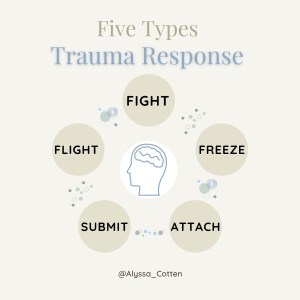
However, it may surprise you to find out that there are five different trauma responses, not just these two choices. 

Before diving into each of these responses, it’s essential first to understand why these automatic physiologic reactions occur at all when we perceive stress.  
The prefrontal cortex of our brain controls judgment, decision making, personality expression, planning complex behaviors, and moderating social behavior. When trauma occurs, our brains go offline, and we rely upon our autonomic nervous system to take over. 

In the case of our hiker analogy, when the hiker hears or sees the bear, their prefrontal cortex doesn’t have enough time to interpret, process, and analyze the situation. Instead, it interprets and then immediately reacts. 

Our emotional trauma responses are similar to this mechanism. Whether the trauma happened five seconds ago or five years ago, our brains are wired to have instinctive reactions.

It is absolutely essential for entrepreneurs to be aware of the signs of their trauma responses so they are able to identify and react appropriately when they occur.  Otherwise, trauma responses can lead to decreased productivity, missed deadlines, hostile work environments and impacted team morale. 

My hope with this blog post is to provide you with an understanding of each of the five different trauma responses. Comprehending each of their signs and tendencies allows us to illuminate our negative behaviors and unhealthy coping habits. 

In no particular order, here are the five different trauma responses:

Fight:
  When experiencing the “fight” trauma response, individuals develop a need for control and become combative and vigilant. Maybe you will notice you’ve become more argumentative with a loved one than usual. Or that you have become more mistrustful or judgmental than you had been in the past. This response can lead to self-destructive or self-sabotaging tendencies.

Flight:
  With the “flight” trauma response, individuals will find themselves doing anything possible to avoid or escape a situation. Whether it’s distancing yourself from friends, refusing to commit to plans, or consuming social media rather than creating your own life experiences, this trauma response can be just as harmful to our mental health as any other.  

Freeze: 
When someone is in the “freeze” trauma response, they are consumed by fear and will only see the bad in situations. Generally, people will be overwhelmed with anxiety and the desire to fly under the radar and be more passive in social settings.

Submit:
 The “submit” trauma response is precisely what it sounds like: the person has submitted themselves to defeat or shame from the situation. Often those experiencing this will have an attitude of “why bother, I know I have lost” to whatever stressors present themselves to them. This manifests into self-hatred and causes them to stop working toward personal goals.

Attach:
 Those who experience the “attach” trauma response will do anything to help themselves feel connected. Whether it’s remaining in a toxic relationship or having promiscuous sex, this trauma response is fueled by a fear of abandonment. Many will feel like they need a connection with another human to help them navigate them through the day. 

These trauma responses will ebb and flow throughout our lives depending on the situation. Our bodies rely on them to protect ourselves from traumatic experiences.  

I encourage you to give compassion when you check in with your body during stressful situations and understand that these trauma responses are normal!
If you have made it this far and are interested in exploring this topic further, check out this video!